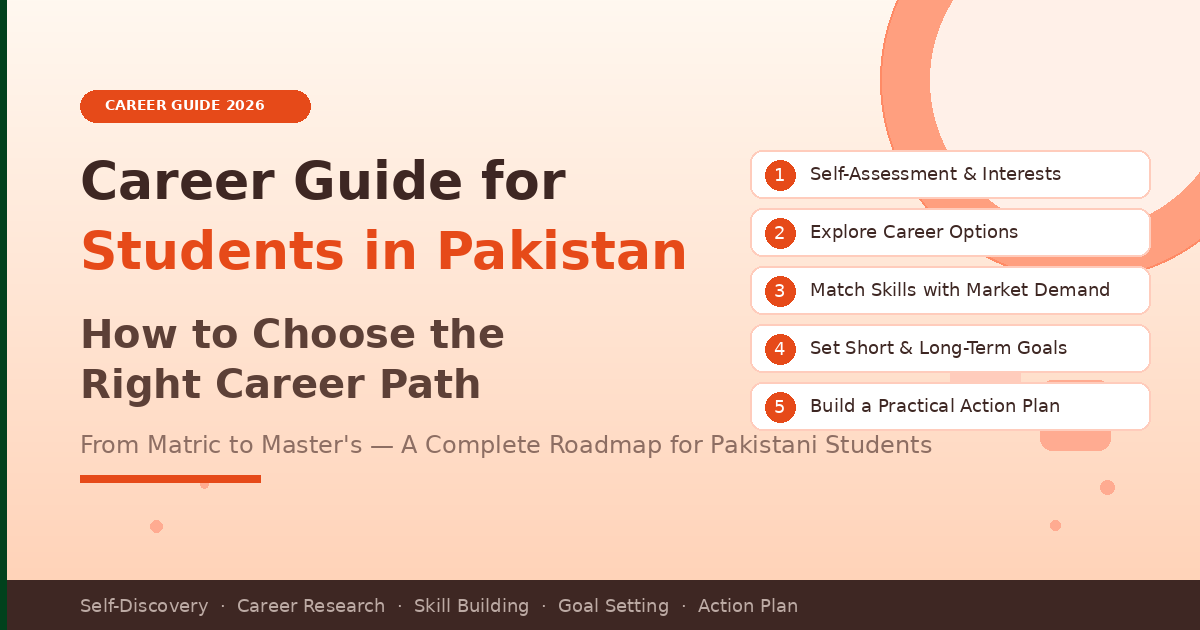
Career Guide for Students in Pakistan: How to Choose the Right Career Path
Choosing a career is one of the most important decisions a student has to make. In Pakistan, students often face pressure from parents, relatives, friends, and society to choose a particular profession.
Many students hear the same advice:
"Become a doctor."
"Choose engineering."
"Computer Science has the most scope."
"Government jobs are the safest."
But there is no single career that is best for everyone.
The right career depends on your interests, abilities, education, financial circumstances, skills, personality, and long-term goals. The Pakistani education and employment landscape also offers far more options than the traditional choices of medicine and engineering.
This career guide will help students understand how to choose a suitable career, evaluate different options, develop useful skills, and create a practical career plan.
Why Choosing the Right Career Matters
Your career choice can influence:
- What you study
- How many years you spend in education
- The skills you develop
- Your employment opportunities
- Your earning potential
- Your lifestyle
- Your future growth
However, choosing a career does not mean you are permanently locked into one profession.
Many people change their career direction after completing a degree or gaining work experience.
The goal is therefore not to predict your entire life at the age of 18.
The goal is to make an informed decision based on the information available to you today.
Step 1: Understand Yourself Before Choosing a Career
The first question should not be:
"Which career has the highest salary?"
Instead, ask:
"What type of work is suitable for me?"
Consider your:
Interests
What subjects or activities do you genuinely enjoy?
For example:
- Biology
- Mathematics
- Computers
- Business
- Writing
- Teaching
- Law
- Design
- Science
- Public service
Strengths
Which activities do you perform well?
You might be good at:
- Mathematics
- Communication
- Problem-solving
- Memorization
- Writing
- Leadership
- Technical work
- Research
- Working with people
Personality
Your personality can also influence career satisfaction.
Some people enjoy working with people every day.
Others prefer:
- Computers
- Research
- Laboratory work
- Numbers
- Creative work
- Outdoor activities
- Independent work
Understanding yourself is the foundation of good career planning.
Step 2: Don't Choose a Career Because of Peer Pressure
One of the most common mistakes students make is following their friends.
Your friend may choose:
Computer Science
and you may choose it simply because your friend is doing it.
But after a few months, you may discover that you don't enjoy programming.
The same applies to medicine, engineering, business, law, or government jobs.
A career decision should be based on your own abilities and goals, not someone else's choice.
Before selecting a field, ask:
"Would I still choose this career if none of my friends were choosing it?"
If the answer is no, reconsider your decision.
Step 3: Consider Your Educational Background
Your current education can influence which career paths are available to you.
For example, students from different Intermediate streams may naturally consider different options.
FSc Pre-Medical
Possible pathways include:
- MBBS
- BDS
- Pharm-D
- DPT
- BS Nursing
- Biotechnology
- Microbiology
- Nutrition
- Public Health
- Other health-related programs
Your exact eligibility depends on the university and program.
FSc Pre-Engineering
Possible areas include:
- Engineering
- Computer Science
- Software Engineering
- Information Technology
- Architecture
- Mathematics
- Physics
- Data-related fields
Eligibility requirements vary by institution.
ICS
Students with a computer-science background may consider:
- Computer Science
- Software Engineering
- Information Technology
- Artificial Intelligence
- Data Science
- Cybersecurity
- Web Development
- Mobile App Development
ICom
Possible pathways include:
- Accounting
- Finance
- Banking
- Business Administration
- Economics
- Commerce
- Marketing
- Entrepreneurship
Professional qualifications such as CA, ACCA, and CMA may also be considered, subject to their respective requirements.
FA / Humanities
Possible areas include:
- Law
- Education
- Psychology
- English
- Political Science
- International Relations
- Media Studies
- Sociology
- Fine Arts
- Government service
The actual options depend on your subjects, university requirements, and career objectives.
Step 4: Research the Career, Not Just the Degree
A degree title does not tell you everything about a career.
Before choosing a program, find out what professionals in that field actually do.
For example, don't simply ask:
"Should I study Computer Science?"
Ask:
- What does a software developer do every day?
- What skills are required?
- What entry-level jobs exist?
- What additional certifications might help?
- Is practical experience important?
- What opportunities exist in Pakistan?
- Can the skills be used internationally?
- What are the challenges of the profession?
The same approach should be used for medicine, engineering, finance, teaching, law, government service, and every other field.
A career should be evaluated by its real work, not just its title.
Step 5: Look Beyond Traditional Careers
Medicine, engineering, teaching, banking, and government service remain important career paths.
However, students today have many additional options.
Technology has created opportunities in areas such as:
- Software development
- Data analysis
- Artificial Intelligence
- Cloud computing
- Cybersecurity
- UI/UX design
- Digital marketing
- E-commerce
- Content creation
- Web development
Other growing areas include business analytics, digital media, health technology, and educational technology.
Recent Pakistani education guidance also emphasizes skills such as AI literacy, communication, critical thinking, digital skills, leadership, and data analysis.
The important point is not to follow every new trend.
Instead, identify a field where you can develop valuable and transferable skills.
Step 6: Learn Skills Alongside Your Degree
A degree is important for many professions, but a degree alone may not be enough.
Try to develop practical skills alongside your education.
Useful skills for many careers include:
Communication
Learn to communicate clearly in both written and spoken form.
English
Strong English can help with education, employment, interviews, research, and professional communication.
Computer Skills
At minimum, become comfortable with:
- Word processing
- Spreadsheets
- Presentations
- Internet research
- Online collaboration
AI Literacy
Understand how modern AI tools work and how they can responsibly be used for learning and productivity.
Critical Thinking
Learn to evaluate information instead of accepting everything you read online.
Problem Solving
Employers value people who can identify problems and develop practical solutions.
Teamwork
Most professional environments require collaboration.
These skills can benefit students regardless of their chosen degree.
Step 7: Consider Government Careers
Government employment remains an important career option for many Pakistani graduates.
Depending on your qualification and interests, opportunities may include:
- Federal government jobs
- Provincial government jobs
- Public service examinations
- Teaching
- Police and administrative services
- Technical positions
- Health-sector positions
- Research positions
- Other departmental recruitment
Competitive examinations such as PPSC, PMS, CSS, and FPSC-related examinations require specific preparation strategies.
If you are interested in competitive exams, start building your general knowledge, English, Pakistan Studies, Current Affairs, and analytical skills early.
You can use PakTestPro's subject-wise MCQs for regular objective-question practice.
You can also explore PakTestPro's exam preparation resources for additional practice.
Step 8: Think About Skills, Not Just Job Titles
Instead of asking:
"Which job should I get?"
ask:
"Which skills can I develop that will give me multiple career options?"
For example, strong communication skills can be useful in:
- Teaching
- Sales
- Management
- Marketing
- Customer service
- Media
- Administration
Similarly, data-analysis skills can be useful in:
- Finance
- Business
- Technology
- Research
- Government
- Marketing
Transferable skills give you flexibility if your career direction changes later.
Step 9: Consider the Cost of Education
Career planning should also be financially realistic.
Before choosing a degree, consider:
- Tuition fees
- Transport
- Accommodation
- Books
- Equipment
- Entry-test costs
- Professional examination fees
- Duration of the program
Don't select a career solely because someone says it has a high salary.
A career that requires substantial financial investment should be evaluated carefully.
Look for:
- Scholarships
- Public-sector institutions
- Financial aid
- Affordable universities
- Skill-development opportunities
Your financial situation should be part of the decision-making process.
Step 10: Check Recognition and Eligibility
Before enrolling in a degree or professional program, verify that the institution and program meet the relevant official requirements.
Check:
- University recognition
- Program accreditation where applicable
- Admission requirements
- Degree eligibility
- Professional licensing requirements
- Recognition for employment or further study
Do not rely solely on advertisements or social-media posts.
Always verify important educational information from the relevant official authority or institution.
Step 11: Talk to People Already Working in the Field
One of the best ways to understand a career is to speak with someone who is already doing the job.
Ask them:
- What do you do every day?
- What skills are most important?
- What do you wish you had known before entering this field?
- What are the biggest challenges?
- How did you get your first job?
- What additional qualifications helped you?
- What would you recommend to a student starting today?
Don't rely on one person's opinion.
Try to speak with several professionals if possible.
Step 12: Get Practical Experience
If possible, gain experience before graduation.
Depending on your field, this could include:
- Internships
- Volunteering
- Freelancing
- University projects
- Research
- Part-time work
- Competitions
- Portfolio projects
- Student societies
For technology students, build projects.
For business students, gain internship experience.
For aspiring teachers, gain classroom experience.
For researchers, participate in research projects.
Practical experience can help you understand whether you actually enjoy a career.
Step 13: Build a Strong CV and Professional Profile
Start building your professional profile before graduation.
Keep a record of:
- Education
- Certifications
- Internships
- Projects
- Competitions
- Skills
- Volunteer work
- Achievements
Don't wait until your first job application to create a CV.
A strong profile develops gradually.
Step 14: Develop a Backup Plan
Having a Plan B is not a sign of failure.
It is good career planning.
For example:
Plan A: Government competitive examination
Plan B: Private-sector employment
Plan C: Professional skill or freelancing
Your backup plan should ideally use skills related to your primary career.
This gives you flexibility without completely abandoning your main goal.
Step 15: Don't Chase Every "High-Scope" Career
You will often hear statements such as:
- "This field has the most scope."
- "Everyone in this field earns a lot."
- "This degree guarantees a job."
- "This is the future."
- "This profession is finished."
Be careful with such claims.
Career outcomes depend on many factors, including:
- Skill level
- Experience
- Location
- Communication
- Education
- Market conditions
- Professional network
- Work quality
- Continuous learning
There is rarely a degree that guarantees success.
A Simple Career Decision Framework
If you are confused between several careers, use this five-step method.
Step 1 — List Your Top 5 Interests
Write down the subjects or activities you genuinely enjoy.
Step 2 — Identify Your Strengths
List the skills you are already good at.
Step 3 — Select 3 Career Options
Don't try to compare 15 careers simultaneously.
Shortlist three realistic options.
Step 4 — Research Each Option
For every career, investigate:
- Education required
- Cost
- Duration
- Daily work
- Skills required
- Job opportunities
- Career growth
- Possible challenges
Step 5 — Make a Decision
Choose the option that provides the strongest combination of:
Interest + Ability + Opportunity + Practicality
Career Planning After Matric
If you have just completed Matric, don't feel pressured to decide your entire professional future immediately.
Your first decision is usually about your next educational pathway.
Possible options may include:
- FSc
- ICS
- ICom
- FA
- Technical education
- Vocational education
- Other recognized programs
Choose according to your interests, academic strengths, eligibility, and long-term goals.
Practical and technical education can also provide pathways to further education and employment; current government education initiatives, for example, include technical pathways connected to higher education and employment.
Career Planning After Intermediate
After Intermediate, students usually have a much broader range of degree and professional options.
Before applying, compare:
- University
- Program
- Cost
- Duration
- Curriculum
- Career opportunities
- Internship opportunities
- Professional recognition
- Further-study options
Don't choose a university simply because it is popular.
Choose a program that supports your long-term career goals.
Career Planning for Graduates
If you have already completed a degree but haven't found the right career, don't assume that your career is over.
Identify:
What do I already know?
What skills am I missing?
What jobs can I realistically apply for?
What additional skill can I learn within 3–6 months?
For example, a graduate can combine their degree with additional skills in:
- Data analysis
- Digital marketing
- Communication
- Project management
- AI tools
- Programming
- Research
- Content development
The combination of degree + practical skills can create more opportunities than relying on the degree title alone.
Career Options for Students Interested in Competitive Exams
If your goal is a government career, start preparing early.
Important areas include:
- English
- General Knowledge
- Pakistan Studies
- Current Affairs
- Everyday Science
- Computer
- Mathematics
- Analytical reasoning
- Relevant subject knowledge
Don't wait until the examination announcement to start learning basic concepts.
Build your knowledge gradually.
You can practice with PakTestPro's topic-wise MCQs and use regular tests to identify your strengths and weaknesses.
Common Career Mistakes Students Should Avoid
Choosing a Career Because of Family Pressure
Your family can provide valuable advice, but you should understand the career before making the final decision.
Following Friends
Your friend's strengths may be completely different from yours.
Choosing Only Based on Salary
Income is important, but career satisfaction, growth, stability, and suitability also matter.
Ignoring Skills
A degree without practical skills can limit your opportunities.
Not Researching the Field
Never choose a profession without understanding what the work actually involves.
Trusting Social Media Completely
Career advice on social media can be useful, but important information should be verified.
Ignoring English and Communication
These skills are valuable in almost every professional field.
Thinking One Decision Determines Your Entire Life
Career paths can change.
Your first decision is important, but it doesn't have to determine every future decision.
A 5-Year Career Development Plan
You can use a simple five-year framework.
Year 1 — Explore
Understand your interests and choose an educational direction.
Year 2 — Learn
Build strong academic foundations and start developing practical skills.
Year 3 — Practice
Complete projects, internships, certifications, or other practical activities.
Year 4 — Specialize
Choose a specific career direction and develop advanced skills.
Year 5 — Launch
Apply for jobs, pursue professional opportunities, start a business, freelance, or continue higher education.
The exact timeline will vary depending on your career.
Frequently Asked Questions
Which career is best in Pakistan?
There is no single best career for everyone. The right career depends on your interests, abilities, education, financial circumstances, and goals.
Should I choose a career based on salary?
Salary should be considered, but it should not be the only factor. Career growth, job suitability, skills, stability, and personal interest are also important.
Is a government job a good career?
Government employment can be a good option for candidates who value public service and the career structure offered by a particular government department. However, it is not the only successful career path.
Is Computer Science a good career?
Computer-related fields offer many opportunities, but success requires genuine interest, continuous learning, and practical skills. The field is broad, covering areas such as software development, data, AI, cybersecurity, cloud computing, and IT.
What skills should every student learn?
Useful general skills include communication, English, digital literacy, critical thinking, problem-solving, teamwork, research, and responsible use of modern AI tools.
Can I change my career later?
Yes. Many people change their specialization or career direction after gaining education or work experience. Building transferable skills makes such transitions easier.
Final Career Checklist
Before choosing a career, ask yourself:
- What subjects do I enjoy?
- What am I naturally good at?
- What type of work do I enjoy?
- What education is required?
- Can I afford the education?
- What does the daily work look like?
- What skills are required?
- What entry-level jobs exist?
- What is the potential for career growth?
- Is the qualification recognized?
- Can I gain practical experience?
- What is my backup plan?
If you can answer these questions honestly, you will be in a much stronger position to make your decision.
Conclusion
Choosing a career is not about finding the profession that everyone else considers successful.
It is about finding a path where your interests, abilities, education, skills, and opportunities come together.
Don't choose a career simply because it is popular. Don't reject a field simply because someone says it has no scope. Research the actual profession, understand the required education, develop practical skills, and make decisions based on reliable information.
Whether you are preparing for university, looking for a professional qualification, planning a government career, or exploring modern digital fields, start with a clear plan.
And remember:
A degree can open a door, but skills, experience, communication, and continuous learning help you move forward.
For students preparing for competitive examinations, PakTestPro's subject-wise MCQ practice can help build knowledge and test preparation skills.
Your career is a long journey. You don't need to know every step today.
You only need to make the next informed step.