How to Prepare for One-Paper Competitive Exams in Pakistan
One-paper competitive exams are a popular route to government and public-sector employment in Pakistan. These examinations usually test candidates across several subjects through multiple-choice questions (MCQs), making broad knowledge, speed, accuracy, and consistent revision extremely important.
Whether you are preparing for a PPSC recruitment test, PMS-related examination, FPSC screening test, or another one-paper examination, success depends on studying systematically rather than simply trying to memorize thousands of facts.
This guide explains how to prepare effectively, organize your study time, use MCQs and past papers, take mock tests, and improve your performance before the examination.
If you are looking for a place to begin your preparation, you can also browse PakTestPro's subjects and practice topic-wise MCQs.
What Is a One-Paper Competitive Exam?
A one-paper examination generally combines questions from several areas into a single written test. Depending on the post and recruiting organization, the subjects and weightage can vary.
Common areas may include:
- General Knowledge
- Pakistan Studies
- Current Affairs
- Everyday Science
- English
- Computer Science
- Islamiat
- Geography
- Mathematics
- Analytical Reasoning
- Related subject knowledge
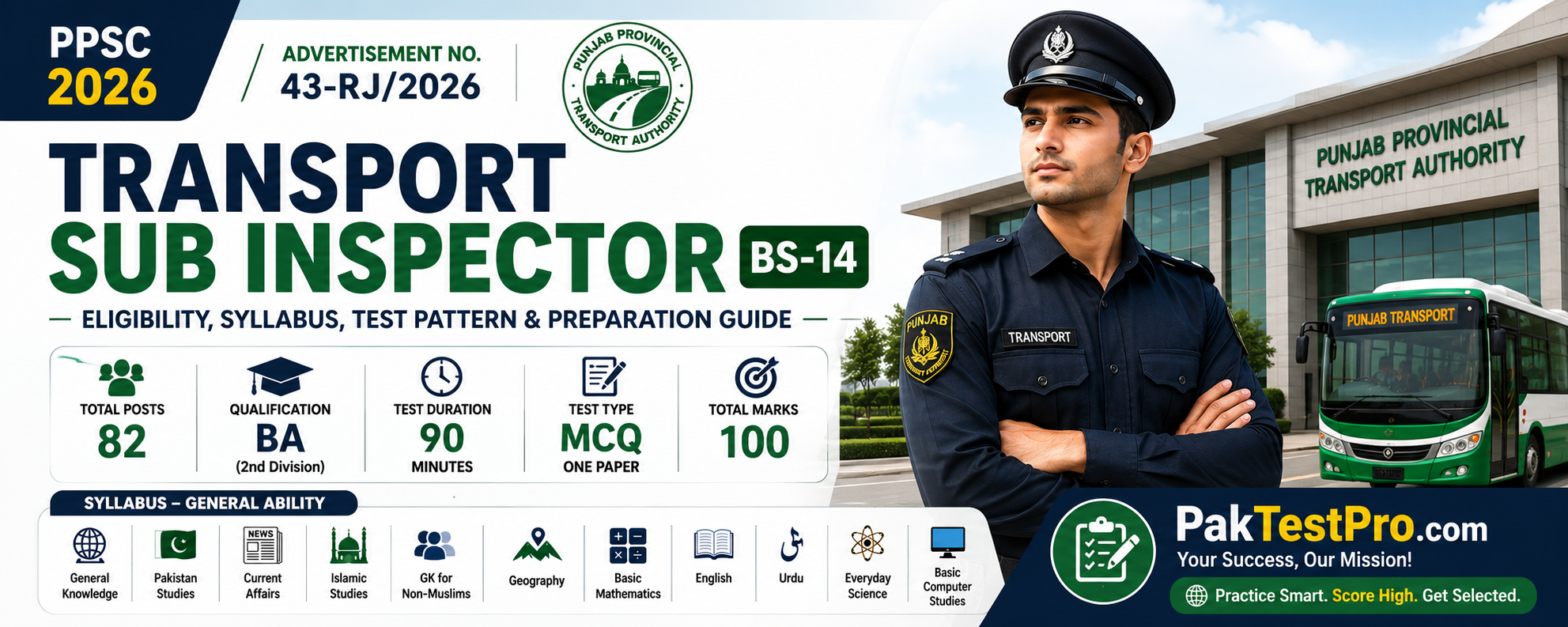
The exact syllabus, number of questions, duration, and eligibility requirements depend on the particular advertisement and recruiting organization. Candidates should always check the latest official advertisement before beginning preparation.
PakTestPro currently provides subject-wise preparation in areas including English, General Knowledge, Current Affairs, Pakistan Studies, Islamic Studies, Computer, Everyday Science, Mathematics, Urdu, Analytical Reasoning, and Acts & Laws. Explore all available subjects and topics.
The biggest challenge is that candidates need to prepare multiple subjects simultaneously.
1. Start by Understanding the Test
Before opening your books, understand exactly what you are preparing for.
Read the relevant job advertisement carefully and identify:
- Exam pattern
- Number of questions
- Test duration
- Syllabus
- Subject areas
- Negative marking, if applicable
- Required qualification
- Any post-specific portion
Do not rely on an old advertisement or an unofficial social-media post for current rules.
Once you understand the test, divide the syllabus into manageable sections.
2. Make a Realistic Study Plan
A good study plan is more important than studying for extremely long hours.
For example, if you have four hours available each day, you could divide your time like this:
| Study AreaSuggested Time | Main Subject | 90 minutes | General Knowledge / Current Affairs | 45 minutes | English | 45 minutes | MCQ Practice | 45 minutes | Revision | 15 minutes |
This is only an example. Your schedule should depend on your available time, strengths, weaknesses, and examination date.
The key is consistency.
Studying four focused hours every day is generally more useful than studying twelve hours on one day and doing nothing for the next several days.
3. Prioritize High-Value Subjects
Do not automatically give equal time to every subject.
Start by identifying:
- Subjects carrying significant weight
- Subjects in which you are weak
- Frequently tested areas
- Topics that can be improved quickly through practice
For example, if your English score is consistently low while you perform well in Pakistan Studies, spending additional time on English may produce a greater improvement in your overall score.
Keep a record of your performance and adjust your study schedule accordingly.
4. Build Strong Basic Concepts
MCQ examinations can sometimes tempt candidates to memorize hundreds of facts without understanding the underlying concepts.
This approach becomes difficult when questions are presented in unfamiliar ways.
Instead, understand the basic concepts first.
For example, when studying Pakistan Studies, don't only memorize dates. Understand the sequence and significance of important historical developments.
Similarly, when studying Everyday Science, understand basic scientific principles rather than memorizing isolated answers.
Conceptual understanding makes revision easier and helps you solve questions that are worded differently from those you have previously seen.
5. Practice MCQs Every Day
MCQ practice should be a central part of your preparation.
After studying a topic, immediately solve questions related to that topic.
A useful learning cycle is:
Study → Practice MCQs → Identify mistakes → Review → Practice again
This is much more effective than simply reading books repeatedly.
PakTestPro provides topic-wise MCQ practice across multiple subjects, allowing you to focus on specific areas instead of attempting completely random questions every time.
Try to record:
- Questions answered correctly
- Questions answered incorrectly
- Questions guessed
- Topics causing repeated mistakes
Your incorrect answers are particularly valuable because they show you where your preparation needs improvement.
6. Use Past Papers Properly
Past papers are one of the most useful resources for competitive-exam preparation.
However, don't simply memorize their answers.
Use them to understand:
- Frequently tested topics
- Question difficulty
- Question style
- Important subjects
- Time pressure
- Areas where your preparation is weak
After completing a past paper, analyze your mistakes.
For example:
You answered 70 out of 100 questions correctly.
Instead of simply recording "70 marks," identify why the remaining 30 were wrong.
Were they caused by:
- Lack of knowledge?
- Confusion between two options?
- Poor reading?
- Careless mistakes?
- Guessing?
- Time pressure?
This analysis can improve your next attempt.
You can explore PakTestPro's available exam papers and practice resources, including papers for PPSC, PMS, CSS and FPSC. The platform currently lists dedicated paper collections for these exam categories.
7. Take Mock Tests
Once you have covered a reasonable portion of the syllabus, start taking full-length mock tests.
Mock tests help you practice the actual examination environment.
During a mock test:
- Set a timer
- Avoid using books or notes
- Attempt the complete paper
- Record your score
- Review every incorrect answer
Don't focus only on your score.
Your goal should be to identify weaknesses.
For example:
Mock Test 1: 58%
After reviewing your mistakes, you identify weaknesses in English and Current Affairs.
You then focus on those areas.
Mock Test 2: 66%
This improvement provides much more useful information than simply taking tests without analyzing them.
PakTestPro is designed around this practice cycle: choose a paper, attempt the questions, submit the paper, review your score, and use the results to identify weak areas.
8. Improve Your Time Management
Knowing the answer is not enough if you cannot complete the paper on time.
Practice solving questions under timed conditions.
During practice tests, calculate approximately how much time you are spending per question.
If you encounter a difficult question, don't allow it to consume excessive time.
Depending on the examination rules, you may be better off marking it for later review and moving to easier questions.
Your strategy should always follow the actual instructions of the examination.
9. Learn How to Eliminate Wrong Options
Sometimes you may not immediately know the correct answer, but you can eliminate obviously incorrect choices.
For example, if two options are clearly inconsistent with the question, narrowing four choices down to two improves your chances when you genuinely need to make an educated choice.
However, guessing strategies should be used carefully, particularly if the examination includes negative marking.
Never assume that a particular guessing strategy is safe without checking the rules of your specific test.
10. Keep Short Revision Notes
Long notes can become difficult to revise near the examination.
Create concise notes containing:
- Important dates
- Definitions
- Important personalities
- Important places
- Key facts
- Formulas
- Difficult vocabulary
- Frequently confused concepts
- Mistakes from practice tests
These notes become particularly useful during the final stages of preparation.
Instead of reading an entire textbook again, you can revise the information you have identified as important.
11. Prepare Current Affairs Systematically
Current Affairs can be difficult because information changes continuously.
Instead of trying to memorize random news stories, organize your preparation into categories such as:
- Pakistan
- International affairs
- Economy
- Science and technology
- International organizations
- Important agreements
- Sports
- Environment
- Major national developments
Focus on understanding the important event, its background, and its significance.
PakTestPro currently provides a dedicated Current Affairs MCQ section, which can be used for practice after studying current-affairs topics.
For time-sensitive information, always verify the latest facts from reliable and authoritative sources before the examination.
12. Don't Ignore English
Many candidates focus heavily on General Knowledge and Pakistan Studies while giving too little attention to English.
Depending on the examination, English questions may cover areas such as:
- Vocabulary
- Synonyms
- Antonyms
- Grammar
- Sentence correction
- Prepositions
- Idioms
- One-word substitutions
- Sentence completion
Regular practice is more effective than trying to improve everything in the final week.
You can use PakTestPro's English MCQs and topic-wise English preparation as part of your regular practice routine.
13. Review Your Mistakes
One of the most effective preparation techniques is maintaining a mistake log.
Whenever you answer a question incorrectly, record:
Question → Correct Answer → Reason for Mistake
For example:
Question: Which organization is associated with a particular international agreement?
Correct Answer: X
My mistake: Confused it with Y.
Review your mistake log regularly.
Questions that you repeatedly get wrong deserve special attention.
This is particularly useful when practicing large MCQ banks because your mistakes reveal the topics that require additional revision.
14. Avoid Information Overload
There are thousands of websites, YouTube videos, PDFs, books, Telegram groups, social-media pages, and preparation resources available online.
More resources do not necessarily mean better preparation.
Using too many resources can actually make preparation confusing.
Choose a manageable set of reliable resources and focus on:
Study → Practice → Analyze → Revise
Rather than constantly switching between sources.
15. Follow a Weekly Revision Cycle
A simple weekly cycle can make preparation more organized.
Monday–Thursday
Learn new topics and practice related MCQs.
Friday
Review the week's difficult topics.
Saturday
Attempt a mock test or past paper.
Sunday
Analyze mistakes and revise weak areas.
You can adjust this schedule according to your own routine.
The important thing is to include regular revision and testing.
16. Use PakTestPro for Practice
Your preparation becomes more effective when learning and testing are combined.
PakTestPro provides:
- Subject-wise MCQ practice
- Past papers and exam practice
- Practice across PPSC, PMS, CSS and FPSC
- Timed exam-style papers
- Performance tracking
For example:
Study Pakistan Studies → Practice Pakistan Studies MCQs → Review incorrect answers → Revise weak topics → Attempt another test
PakTestPro currently has dedicated preparation resources across subjects including General Knowledge, Pakistan Studies, Current Affairs, English, Computer, Everyday Science, Mathematics and others.
This creates a continuous preparation cycle rather than relying only on passive reading.
Common Mistakes to Avoid
Studying Without a Plan
Randomly jumping between subjects wastes time.
Only Reading Books
Reading without solving questions does not adequately prepare you for an MCQ-based examination.
Ignoring Past Papers
Past papers provide valuable information about question patterns and important areas.
Taking Mock Tests Without Analysis
A test score alone does not tell you how to improve.
Starting Current Affairs Too Late
Current Affairs should be reviewed regularly rather than left entirely for the final few days.
Using Too Many Resources
Too many books and websites can create confusion.
Ignoring Weak Subjects
Candidates often continue studying subjects they already enjoy while avoiding difficult areas.
Memorizing Without Understanding
Conceptual understanding makes revision and unfamiliar questions easier.
A Simple 30-Day Preparation Plan
If you have approximately one month, you can divide your preparation into four stages.
Week 1: Build the Foundation
- Understand the syllabus
- Organize study material
- Start major subjects
- Begin daily MCQ practice
- Start English and Current Affairs revision
Week 2: Expand Coverage
- Continue major subjects
- Increase MCQ practice
- Start solving past-paper questions
- Identify weak areas
Week 3: Practice Intensively
- Attempt regular mock tests
- Solve past papers
- Review mistakes
- Strengthen weak subjects
- Revise short notes
Week 4: Final Revision
- Focus on weak areas
- Review mistake logs
- Attempt timed mock tests
- Revise important facts
- Avoid starting too many new resources
The exact schedule should be adjusted according to the examination syllabus and your preparation level.
Frequently Asked Questions
How many hours should I study for a one-paper exam?
There is no universal number. The important factors are consistency, concentration, syllabus coverage, and practice. A realistic daily schedule that you can maintain is better than an unsustainable timetable.
Are past papers important for one-paper exams?
Yes. Past papers can help you understand the style and difficulty of questions and identify frequently tested areas. They should be used for analysis and practice rather than simple memorization.
Should I practice MCQs every day?
Daily MCQ practice is highly recommended for an MCQ-based examination. It helps improve recall, speed, accuracy, and familiarity with different question formats.
When should I start taking mock tests?
You can start topic-based tests early and move toward full-length timed mock tests as you cover more of the syllabus.
How should I prepare Current Affairs?
Organize Current Affairs by major themes and review them regularly. Focus on important developments rather than trying to memorize every piece of daily news.
Is it better to use many preparation books?
Usually, quality and consistency are more important than quantity. Select reliable resources and use past papers and practice tests to determine what you actually need to study.
Conclusion
Preparing for a one-paper competitive exam requires a balanced combination of knowledge, practice, revision, and time management.
Start by understanding the examination requirements. Build a realistic study plan, strengthen your concepts, practice MCQs regularly, solve past papers, take timed mock tests, and carefully analyze your mistakes.
Most importantly, don't measure your preparation only by the number of hours you study. Measure it by your accuracy, improvement, syllabus coverage, and performance in timed tests.
A disciplined preparation routine can turn a large syllabus into manageable daily tasks.
If you are ready to start practicing, explore PakTestPro's subjects and topic-wise MCQs or browse the available exam papers.
Start with one subject, practice consistently, review your mistakes, and gradually build your performance until you are ready for the actual examination