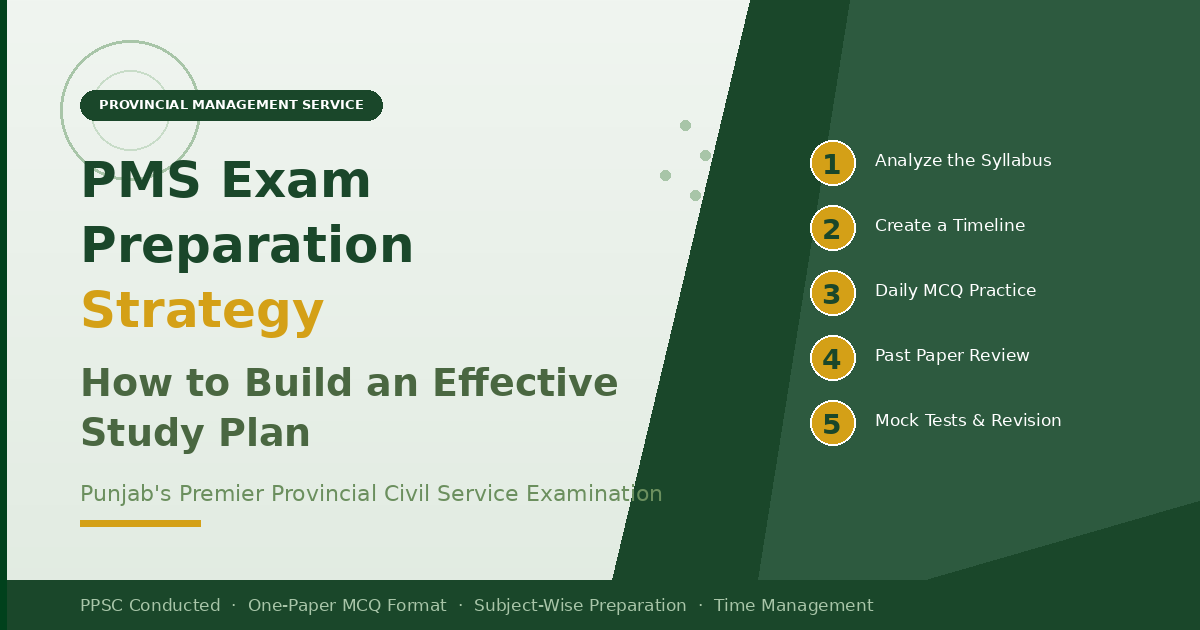
PMS Exam Preparation Strategy: How to Build an Effective Study Plan
Preparing for the Provincial Management Service (PMS) examination requires discipline, patience, and a well-organized study strategy. Unlike a simple one-paper MCQ test, PMS preparation can involve multiple subjects, written answers, English skills, current affairs, and analytical preparation.
For beginners, the biggest challenge is often not a lack of study material. It is knowing what to study, when to study it, and how to revise it effectively.
A good study plan can turn a large syllabus into manageable daily tasks.
This guide explains how to build an effective PMS preparation strategy, organize your subjects, practice MCQs and past papers, improve answer writing, prepare Current Affairs, and avoid common preparation mistakes.
Important: PMS examination rules, syllabus, eligibility requirements, subjects, and paper patterns may vary by province and can change over time. Always verify the latest official information and advertisement from the relevant Public Service Commission before beginning your final preparation plan.
What Is the PMS Examination?
Provincial Management Service (PMS) examinations are conducted by provincial public service commissions to recruit candidates for provincial government services.
The exact examination structure depends on the province and the applicable recruitment rules.
For candidates preparing for PMS in Punjab, the relevant examination information should be verified through the latest official PPSC advertisement and syllabus.
PMS preparation generally requires a combination of:
- Compulsory subjects
- Optional subjects
- English preparation
- Pakistan Affairs
- Current Affairs
- General Knowledge
- Analytical preparation
- Written-answer practice
- Revision and testing
Because the examination covers multiple areas, preparation should be treated as a long-term project rather than a short-term memorization exercise.
1. Start With the Official Syllabus
The first step in PMS preparation should always be understanding the syllabus.
Do not begin by randomly collecting books, PDFs, notes, or online lectures.
First identify:
- Compulsory subjects
- Optional subjects
- Marks distribution
- Paper structure
- Syllabus topics
- Written examination requirements
- English requirements
- Any applicable negative marking
- Current rules and eligibility requirements
The exact requirements can change, so use the latest official information for your examination.
Once you understand the syllabus, divide every subject into smaller topics.
For example:
Subject → Topic → Subtopic → Study Material → Practice → Revision
This makes preparation much easier to manage.
For objective-question preparation, you can also use PakTestPro's subject-wise MCQs to reinforce important concepts.
2. Select Optional Subjects Carefully
Optional-subject selection can significantly influence your preparation.
Don't select a subject simply because someone claims it is "easy" or "high scoring."
Instead, consider:
- Your educational background
- Previous knowledge
- Personal interest
- Syllabus length
- Availability of quality resources
- Your ability to understand the subject
- Your ability to write analytical answers
A subject that is suitable for one candidate may not be suitable for another.
Read the official syllabus for every potential subject before making your final decision.
3. Divide Your Preparation Into Phases
Trying to complete the entire PMS syllabus simultaneously can become overwhelming.
A better approach is to divide preparation into phases.
Phase 1 — Foundation
Build basic understanding of your subjects.
Phase 2 — Detailed Study
Cover the syllabus systematically and prepare notes.
Phase 3 — Practice
Solve past-paper questions and begin answer writing.
Phase 4 — Revision
Review completed topics and identify weak areas.
Phase 5 — Testing
Take full-length tests and practice under time constraints.
This approach creates a clear progression from learning to examination readiness.
4. Create a Daily Study Schedule
Your study schedule should be realistic.
For example, a candidate who can study six hours a day might use:
| ActivitySuggested Time | |
| Main Subject | 2 hours |
| Second Subject | 1.5 hours |
| English | 1 hour |
| Current Affairs | 45 minutes |
| MCQ Practice | 30 minutes |
| Revision | 15 minutes |
This is only a sample.
Candidates with jobs, university commitments, or family responsibilities should adjust the timetable according to their circumstances.
The objective is not to create the longest timetable.
The objective is to create a timetable you can follow consistently.
5. Make English a Daily Habit
English should not be treated as a subject that you can prepare in the final few weeks.
Build daily practice into your routine.
Work on:
- Grammar
- Vocabulary
- Sentence structure
- Comprehension
- Precis
- Sentence correction
- Synonyms
- Antonyms
- Idioms
- Written expression
Read quality English material regularly and learn new vocabulary in context.
You can supplement your preparation with English MCQ practice on PakTestPro.
However, remember that PMS written preparation requires more than objective questions. You should also practice writing clearly and organizing arguments.
6. Prepare Current Affairs Systematically
Current Affairs should be part of your daily preparation.
Don't try to memorize every news headline.
Instead, focus on major issues and understand their background.
Useful areas include:
- Pakistan's economy
- Governance
- Foreign policy
- Regional relations
- International organizations
- Climate change
- Energy
- Water security
- Population and demographics
- Science and technology
- Major national developments
- Important international developments
For each major issue, ask:
What happened?
Why is it important?
What caused it?
What are its consequences?
How does it affect Pakistan?
What solutions are possible?
This method develops the analytical thinking required for written examinations.
For additional factual practice, you can use Current Affairs MCQs on PakTestPro.
Always verify time-sensitive information through reliable and authoritative sources.
7. Prepare Pakistan Affairs With Understanding
Pakistan Affairs should not be prepared solely by memorizing dates and names.
Build a timeline and understand the relationship between important events.
Important areas may include:
- Pakistan Movement
- Constitutional development
- Political history
- Governance
- Federalism
- Economy
- Foreign policy
- Relations with neighboring countries
- Water and energy
- Social development
- Demographic challenges
- Contemporary national issues
When preparing notes, use a structure such as:
Issue → Background → Causes → Effects → Challenges → Government response → Recommendations
This structure can later help you construct analytical answers.
You can strengthen factual recall with Pakistan Studies MCQs on PakTestPro.
8. Practice Answer Writing Early
One of the biggest PMS preparation mistakes is delaying answer writing.
Reading and making notes are not enough.
You need to practice converting information into a structured answer.
A basic answer structure can be:
Introduction
Introduce the topic and establish the main argument.
Background
Provide relevant context.
Main Discussion
Explain the major dimensions of the issue.
Analysis
Discuss causes, consequences, challenges, and different perspectives.
Recommendations
Where appropriate, provide realistic solutions.
Conclusion
Summarize your argument clearly.
Start with short answers and gradually practice longer responses.
Focus on:
- Clear arguments
- Relevant examples
- Logical structure
- Simple and precise language
- Headings where appropriate
- Evidence
- Balanced analysis
9. Practice Essay Writing
Essay preparation should start early.
Don't wait until the examination is close.
Before writing an essay, first understand the topic.
Ask yourself:
- What exactly is the topic asking?
- What is my central argument?
- What are the major dimensions?
- What evidence can I use?
- What examples are relevant?
- What counterarguments exist?
- What recommendations can I provide?
Start by practicing outlines.
For example:
Introduction
→ Background
→ Causes
→ Effects
→ Challenges
→ Pakistan's perspective
→ Recommendations
→ Conclusion
The structure should be adapted to the actual topic.
10. Use PMS Past Papers Strategically
Past papers are extremely useful because they show you how knowledge is converted into examination questions.
Use them to identify:
- Frequently tested topics
- Question trends
- Important themes
- Expected depth
- Areas requiring additional preparation
- Your own weaknesses
Don't simply memorize old answers.
Instead, take a past question and study the broader topic behind it.
For example:
Past Question: Pakistan's economic challenges
Don't prepare only that one question.
Study:
Economy → Historical background → Major challenges → Causes → Effects → Reforms → Future strategy
This gives you preparation that can be adapted to different questions.
You can explore PakTestPro's exam and paper preparation resources to complement your study and practice.
11. Use MCQs to Strengthen Factual Knowledge
PMS preparation involves substantial written work, but MCQ practice is still useful.
It can strengthen your factual recall in areas such as:
- General Knowledge
- Pakistan Studies
- Current Affairs
- English
- Everyday Science
- Geography
- Computer
- Islamic Studies
- Mathematics
Use MCQs after studying a topic.
For example:
Study Topic → Solve 20–30 MCQs → Review Mistakes → Revise
PakTestPro provides subject-wise MCQ practice that can be incorporated into this cycle.
Remember that MCQs should supplement your written preparation, not replace it.
12. Maintain a Current Affairs Notebook
Instead of saving hundreds of articles, create concise notes.
For each major issue, record:
- What happened?
- Background
- Important facts
- Causes
- Effects
- Pakistan's position
- Challenges
- Possible solutions
For example:
Climate Change
Background: Increasing environmental pressures globally.
Pakistan's relevance: Vulnerability to climate-related risks.
Challenges: Water, agriculture, infrastructure and economic effects.
Possible solutions: Adaptation, resilience, sustainable development and improved planning.
Keep the notes concise and update them as the issue develops.
13. Keep a Mistake Log
Your mistakes provide direct information about your weaknesses.
Create a record such as:
| AreaProblemImprovement | ||
| English | Weak vocabulary | Daily vocabulary practice |
| Current Affairs | Poor analysis | Read analytical material |
| Pakistan Affairs | Weak chronology | Revise historical timeline |
| Essay | Weak structure | Practice outlines |
| Optional Subject | Conceptual gap | Revisit core material |
Review this list every week.
If you repeatedly make the same mistake, don't simply practice more questions.
Find the reason behind the mistake and fix the underlying weakness.
14. Revise Using Spaced Repetition
One of the biggest problems in long-term preparation is forgetting what you studied several weeks earlier.
Use a revision cycle.
For example:
First Review: Same day
Second Review: After 2–3 days
Third Review: After one week
Fourth Review: After two weeks
Final Review: Before the examination
You can adapt this schedule according to the subject and difficulty.
Short, repeated revision sessions are often more effective than trying to relearn an entire subject at the end.
15. Take Regular Mock Tests
Testing should be part of your preparation long before the final examination.
Start with:
- Topic tests
- Subject tests
- Past-paper practice
Then progress to:
- Full-length tests
- Timed papers
- Complete examination simulations
After each test, analyze:
- Knowledge gaps
- Weak topics
- Time management
- Repeated mistakes
- Question selection
- Answer quality
A mock test is useful only if you learn something from it.
16. Improve Your Time Management
PMS preparation involves a large amount of material.
Without time management, candidates often spend too much time on a few subjects and leave others incomplete.
At the beginning of each week, decide:
- Which topics will be completed?
- Which subjects require revision?
- How many questions will be practiced?
- How many answers will be written?
- Which Current Affairs issues will be reviewed?
At the end of the week, compare your actual progress with your plan.
If you consistently fall behind, reduce the number of daily targets rather than abandoning the entire schedule.
17. Avoid Resource Overload
PMS candidates have access to a huge amount of preparation material.
You may find:
- Books
- Academy notes
- YouTube lectures
- PDFs
- Websites
- Telegram groups
- Social-media pages
- AI-generated notes
More resources do not necessarily mean better preparation.
Choose reliable sources and finish them properly.
A useful rule is:
One good source studied thoroughly is better than ten sources studied superficially.
18. Build Your Own Revision System
Every candidate has different strengths and weaknesses.
Your revision system should therefore be personalized.
For example:
Strong Subject
Review once a week.
Average Subject
Review twice a week.
Weak Subject
Practice and revise frequently until performance improves.
Use your test results to decide how much time each subject deserves.
A Practical 90-Day PMS Study Plan
If you have approximately three months for focused preparation, you can organize your study into three stages.
Month 1 — Foundation
Focus on:
- Understanding the syllabus
- Selecting optional subjects
- Building basic concepts
- Starting English preparation
- Starting Current Affairs
- Creating notes
- Beginning MCQ practice
Month 2 — Intensive Study
Focus on:
- Completing major portions of the syllabus
- Practicing past-paper questions
- Writing answers
- Preparing essay outlines
- Current Affairs analysis
- Revising completed topics
Month 3 — Testing and Revision
Focus on:
- Full-length tests
- Past papers
- Essay practice
- Answer writing
- Weak areas
- Revision notes
- Time management
Adjust this framework according to the actual examination schedule and your personal preparation level.
Common PMS Preparation Mistakes
Starting Without the Syllabus
You may waste valuable time on irrelevant material.
Choosing Optional Subjects Without Research
A subject should match your background, interest, and ability.
Ignoring English
Weak English can affect several areas of written preparation.
Memorizing Without Understanding
PMS written questions require explanation and analysis.
Delaying Answer Writing
Writing skills improve through practice, not reading alone.
Ignoring Past Papers
Past questions provide valuable insight into examination trends.
Leaving Current Affairs Until the End
Current Affairs requires continuous reading and understanding.
Using Too Many Resources
Resource overload can slow your progress.
Not Revising
Long-term preparation requires repeated revision.
Taking Tests Without Analysis
A test is valuable only when you learn from the results.
Frequently Asked Questions
How should I start PMS preparation?
Start with the latest official syllabus and examination requirements. Select your subjects carefully, divide the syllabus into topics, create a realistic timetable, and begin systematic study and practice.
How many hours should I study for PMS?
There is no universal number. Your study hours should depend on your available time, preparation level, and examination schedule. Consistency is more important than simply counting hours.
How long does PMS preparation take?
Preparation time varies from candidate to candidate. Your academic background, optional subjects, available study time, and existing knowledge all affect how long you may need.
Are PMS past papers important?
Yes. Past papers help you understand question trends, identify important topics, practice answering questions, and evaluate your preparation.
Should I practice MCQs for PMS?
Yes. MCQs are useful for strengthening factual knowledge, especially in General Knowledge, Pakistan Studies, Current Affairs, English, Science, and other objective areas. However, written-answer practice should remain an important part of PMS preparation.
How can I improve my PMS English preparation?
Practice English regularly. Focus on grammar, vocabulary, comprehension, precis, sentence structure, and written expression. Consistent practice is more useful than last-minute preparation.
How should I prepare Current Affairs for PMS?
Follow major national and international issues regularly. Understand their background, causes, consequences, relevance to Pakistan, and possible solutions rather than memorizing isolated headlines.
Final PMS Preparation Checklist
Before the examination, make sure you have:
- Read the latest official syllabus
- Understood the examination structure
- Selected suitable optional subjects
- Completed major syllabus areas
- Prepared Current Affairs notes
- Improved English skills
- Practiced essay writing
- Practiced analytical answers
- Solved relevant past papers
- Practiced MCQs
- Taken timed tests
- Reviewed mistakes
- Revised weak areas
- Prepared concise final notes
Conclusion
A successful PMS preparation strategy is built around planning, consistency, understanding, practice, and revision.
Start by understanding the official syllabus and examination requirements. Select your subjects carefully and divide the syllabus into manageable topics.
Study your subjects systematically, prepare Current Affairs throughout your preparation, improve your English, practice analytical writing, solve past papers, and use MCQs to strengthen factual knowledge.
Most importantly, don't measure your preparation only by the number of books you have completed.
Measure it by:
What you understand → What you can explain → What you remember → How well you perform under examination conditions.
You can use PakTestPro's subject-wise MCQs for objective-question practice and PakTestPro's exam resources as a supplementary preparation tool.
A strong PMS preparation plan does not need to be complicated.
Plan your subjects. Study consistently. Practice regularly. Analyze your mistakes. Revise repeatedly.
With a disciplined approach, a large PMS syllabus can be broken down into manageable daily goals.